

Welcome to the ultimate guide from Jupiter Blue, where we believe accessing your valuable storage space should be safe, simple, and hassle-free. The title says it all: Loft and Attic Access Ladders: Choosing the Right Ladder for Safe Home Access. This is the first, crucial step toward transforming an underutilised overhead void into practical, accessible storage. Whether you’re looking to store seasonal items, manage insulation, or simply declutter your home, finding the perfect loft access ladder is paramount. Why? Because our brains trick us into risky shortcuts, like stacking chairs, until a proper system nudges us right.
- Choosing Quality Loft and Attic Access Ladders
- Why Safe Loft and Attic Access is Non-Negotiable
- Step 1: Choosing the Right Material for Your Loft and Attic Access Ladders
- Step 2: Folding vs. Zedfold Loft Ladder Access Systems
- Step 3: Sizing Up Your Space and Requirements
- Step 4: Prioritising Safety Features and Installation
- Your Next Step Towards Safe Access
Choosing Quality Loft and Attic Access Ladders
Choosing quality loft and attic access ladders is about more than just finding a way up; it’s about investing in the long-term safety, efficiency, and functionality of your home. This buyer’s guide is designed to walk you through the four key decisions you need to make, ensuring your new loft access with ladder system meets your exact needs, budget, and safety expectations. Our aim is to provide you with the professional, friendly advice you need to make the right choice, hassle-free.
Why Safe Loft and Attic Access is Non-Negotiable
Every homeowner understands the value of extra space, but attempting to reach your loft using precarious methods like kitchen chairs or old stepladders poses serious risks. Professional, purpose-built solutions are not a luxury; they are a necessary safety investment.
The stark reality of domestic hazards highlights this necessity. According to estimates from the Royal Society for the Prevention of Accidents (RoSPA), a staggering 6,000 people a year are killed in the UK from unintentional accidents in the home. These accidents are often preventable and usually stem from using inappropriate, unsecured, or faulty equipment.
A dedicated, permanently installed residential loft ladder ensures that every entry and exit to your attic is secure, stable, and compliant with safety standards, eliminating the need for hazardous makeshift arrangements. Don’t compromise your well-being for a quick fix; choose a proper ladder attic access system designed for frequent, safe use.
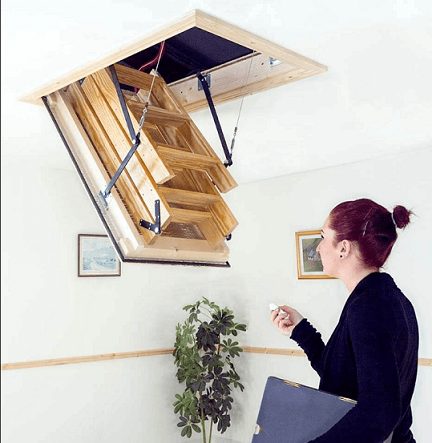
Remote Control Loft Hatch
Step 1: Choosing the Right Material for Your Loft and Attic Access Ladders
The material you select for your loft and attic access ladders is critical, affecting everything from durability and load-bearing capacity to insulation properties and overall look.
Aluminium Attic Access Ladders
Aluminium remains one the most popular choices for loft and attic access ladders, and for good reason. They are inherently lightweight, making them incredibly easy to manoeuvre and lower, even for regular use. Their robust metal construction provides excellent load-bearing capacity without adding unnecessary bulk to the overall attic access with ladder mechanism. Aluminium loft ladders are also resistant to warping, twisting, and corrosion, offering fantastic longevity.
If you plan on accessing your loft frequently, a high-quality aluminium ladder for loft access system is a highly reliable and durable option. They are especially suitable for heavy storage loads or when the ladder will be used by multiple people for various tasks.
Timber Loft Access Ladders
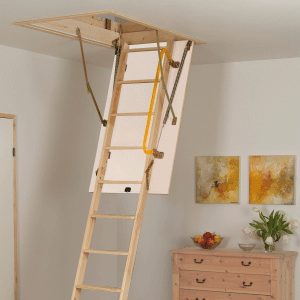
Most loft and attic access ladders are used infrequently – which makes comfort even more important. Timber’s wider treads feel more stable underfoot, and because it doesn’t transmit cold like metal, it avoids that unpleasant winter shock to your hands and feet. Timber ladders, typically constructed from high-quality spruce or pine, blend seamlessly with existing internal joinery and woodwork. Beyond their visual charm, they often come integrated with the hatch door, providing superior insulation compared to basic metal models.
Step 2: Folding vs. Zedfold Loft Ladder Access Systems
The mechanism by which your loft ladder deploys is a key practical consideration. The choice between a folding system and a Zedfold (concertina-style) system largely depends on the size of your loft opening and the available landing space below.
Folding Loft Ladder Access Systems (Sectional)
Folding or sectional ladders are the traditional and most widely recognised option. These typically consist of two, three, or four hinged sections that fold back onto the hatch door when stored.
They are extremely stable when deployed and are available in both timber and metal. When fully integrated into a loft hatch system, they create a sturdy and rigid access point — often feeling close to a fixed staircase.
However, they require adequate landing space directly beneath the hatch. Because the sections unfold in an arc, they need sufficient “swing clearance” to deploy safely. Measuring this landing space correctly is essential to ensure obstruction-free installation.
If you have generous floor space below the hatch, a folding system is often the ideal choice.
Zedfold (Concertina) Loft Ladder Systems
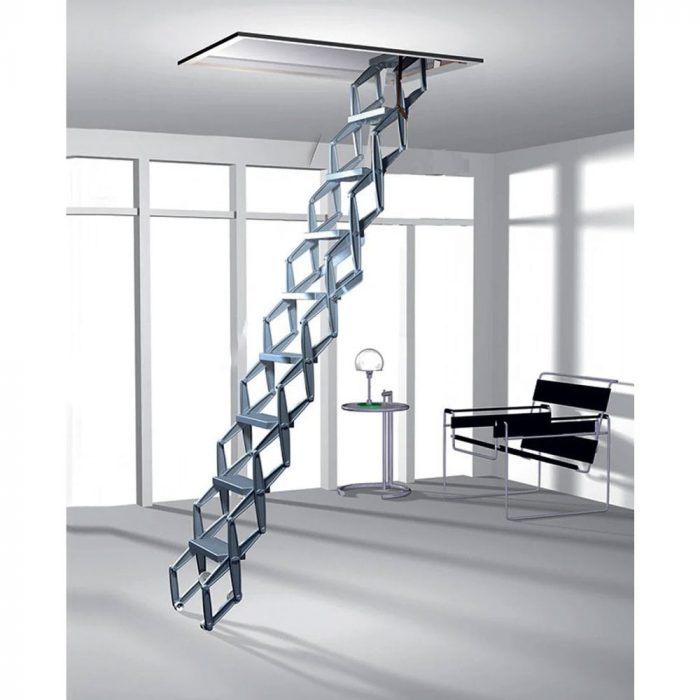
Zedfold ladders, sometimes referred to as concertina or scissor-style ladders, operate differently. Instead of unfolding in long sections, they extend vertically in a compact zig-zag motion. This makes them exceptionally space-efficient.
Because they drop down almost straight rather than swinging out in a wide arc, Zedfold systems are ideal where:
- The loft hatch is close to a wall
- There is a doorway nearby
- Landing space is limited
- The room layout restricts full swing clearance
When stored, they retract neatly above the hatch, preserving valuable floor area. For properties where space planning matters, such as smaller landings, hallways, or tight utility areas, Zedfold ladders provide a highly practical solution.
Modern Zedfold designs are engineered for strength and stability, with deep treads and controlled deployment mechanisms to ensure safe and confident use.
Step 3: Sizing Up Your Space and Requirements
Choosing the right size is paramount, both for safety and for making the most of your untapped resource. Making proper use of your loft space has proven benefits, including significant financial returns. Creating accessible, functional storage space in your loft could increase the value of your home. Correct sizing is the foundation of this investment.
Measuring Your Attic Access Hatch and Ladder Opening
Before ordering any attic access hatch and ladder kit, accurate measurements are essential. You must measure:
Hatch Dimensions: The width and length of the opening in the ceiling joists (or the existing hatch frame). Ensure the ladder system you choose is compatible with this specific opening size. Choosing a hatch that is too small will restrict movement, while one that is too large may compromise the ceiling structure.
Floor-to-Ceiling Height: The vertical distance from the floor surface to the ceiling surface. This is the most crucial measurement, as the loft access ladder must be long enough to reach the floor at a safe climbing angle (usually around 75 degrees) without being too long (which would prevent it from deploying correctly or cause damage to the floor). Never attempt to use a ladder that is too short for the required height.
Landing Clearance: As discussed in Step 2, measure the swing clearance – the arc the ladder will travel as it unfolds. This ensures the ladder won’t foul on furniture, walls, or fixtures.
The Importance of Weight Rating
All quality ladders for attic access will have a maximum weight rating, usually expressed in kilograms (kg) or stones. This rating is not something to estimate; it must be adhered to strictly. You must factor in not only the weight of the heaviest user but also the weight of any tools or items they will be carrying up the ladder. Always select a ladder with a capacity that significantly exceeds your anticipated maximum load to guarantee safety and prevent structural failure or bending of the treads.
Step 4: Prioritising Safety Features and Installation
Safety is the heart of Jupiter Blue’s philosophy. Safe loft and attic access ladders are defined by their build quality and the features engineered into its design. Taking the time to choose a model with enhanced safety features drastically reduces risk and provides peace of mind whenever you require attic ladder access.
Essential Safety Features of Quality Loft and Attic Access Ladders
When reviewing models for your home, look out for the following non-negotiable safety features and ladder accessories:
- Non-Slip Treads/Steps: The steps should be wide and deep, often with a patterned surface, rubber grip, or deep grooved treads to provide maximum foot stability and grip when climbing or descending, regardless of footwear.
- Handrails: Whether integrated into the side of the unit or supplied as a fitment kit, robust handrails are vital for maintaining three points of contact when using the ladder. This is arguably the most critical feature for preventing falls.
- Spring/Piston Assistance: High-quality metal and timber systems use powerful springs or gas pistons to counterbalance the weight of the ladder, ensuring safe, slow, and controlled lowering and raising. This prevents the loft access ladder from crashing down unexpectedly and eliminates the need for excessive force from the user.
- Insulated and Sealed Hatch: Since the loft hatch acts as a barrier between your heated living space and the cold loft, a properly insulated, draught-proof hatch is essential for home efficiency, preventing heat loss and saving you money on energy bills. All Jupiter Blue loft hatches are well insulated.
Combining the Attic Access Hatch with Ladder for Maximum Safety
For the safest and most efficient solution, we always recommend purchasing an integrated unit – an attic access hatch with ladder kit. These are factory-assembled, tested, and designed to work together perfectly, ensuring the structural integrity of the entire system. When professionally installed, these integrated units ensure the entire system (the frame, the trapdoor, and the ladder), is structurally sound, airtight, and completely secure, offering the very best in loft access with ladder functionality and protection. This combination simplifies the installation process and guarantees the ladder is correctly mounted for reliable performance.
Your Next Step Towards Safe Access
Choosing the right loft and attic access ladder system is an investment in your home’s safety, efficiency, and usable space. By focusing on material, mechanism, size, and safety features, you ensure secure attic ladder access for many years to come.
Ready to explore high-quality, professional residential loft hatch ladders and integrated hatch systems? Visit the Jupiter Blue Access Ladders section today to view our full range of timber, aluminium, and telescopic models, or contact our friendly product specialists for expert advice tailored to your home’s unique needs.
We are here to help you access your loft simply and safely.